Site Supervisor Jobs in 2026: Career Path, SSSTS vs SMSTS & What Employers Want
By Onboard Jobs on - 10 minute read time

If you are an experienced tradesperson or skilled operative ready to take greater responsibility on site, site supervisor jobs can provide a clear route into construction leadership. The role combines practical construction knowledge with planning, communication, health and safety supervision and team coordination.
In 2026, employers are looking for supervisors who can keep work moving safely and efficiently. SSSTS or SMSTS training can support your progression, but neither course guarantees employment on its own. You will also need relevant occupational competence, site experience and evidence that you can lead people and control work activities.
What does a site supervisor do?
A site supervisor acts as the link between site operatives, subcontractors and senior site management. You may supervise a particular trade, work package, section of a project or several teams, depending on the size and type of site.
Your daily responsibilities may include:
- Coordinating trades, subcontractors and deliveries.
- Allocating work and checking that teams understand their tasks.
- Reviewing drawings, specifications and short-term programmes.
- Checking that risk assessments and method statements (RAMS) are suitable and understood.
- Leading toolbox talks, briefings and inductions.
- Monitoring high-risk work, including work at height, lifting operations, excavations, hot works and work near services.
- Checking quality against drawings and specifications.
- Supporting productivity by resolving access, sequencing, materials and plant issues.
- Maintaining health and safety standards and intervening when work is unsafe.
- Recording progress, labour, plant, materials, incidents, inspections and delays.
- Reporting problems to the site manager, project manager or relevant specialist.
- Supporting environmental, quality and housekeeping requirements.
The Skills England construction site supervisor occupational standard describes the role as overseeing construction operations, coordinating workers and workflows, maintaining compliance and supporting delivery against project plans and specifications.
A typical day on site
At the start of a shift, you may review the programme, check the work areas and confirm that the correct teams, materials and equipment are available. You will then brief workers on the planned activities and any hazards or changes to the work sequence.
Before higher-risk activities begin, check the relevant RAMS and confirm that everyone involved understands the controls. A short toolbox talk may be needed to cover the specific task, access arrangements, exclusion zones, permits, emergency procedures and stopping points.
During the day, walk the site regularly. Check that work follows the agreed method, that quality standards are being maintained and that workers have the resources needed to remain productive. If conditions change, stop and escalate the issue, review the safe system of work and ensure the team is re-briefed.
The Health and Safety Executive describes a toolbox talk as a short presentation to the workforce on one aspect of health and safety. As a supervisor, you must make these briefings relevant to the work taking place rather than treating them as a routine formality.
How to become a site supervisor
There is no single route into site supervision. Many supervisors begin as skilled operatives or tradespeople and build responsibility through experience.
A typical progression route looks like this:
- Develop occupational competence in a trade or construction discipline.
- Build site experience and learn how different trades interact.
- Take responsibility for small teams or work areas.
- Support supervisors and site managers with briefings, inspections, quality checks and coordination.
- Complete relevant health and safety training, such as SSSTS.
- Work towards a relevant supervisory qualification or NVQ/SVQ.
- Apply for assistant supervisor, working supervisor or site supervisor jobs.
- Continue developing your leadership, technical and management skills.
Employers value people who understand the practical realities of construction. Your experience may include setting out work, interpreting drawings, coordinating subcontractors, checking materials, resolving site issues or mentoring apprentices.
You do not need to be the most senior person on site to demonstrate leadership. If you have organised a work gang, delivered a briefing, checked another worker’s work or raised a safety concern, you already have evidence that can support your move into supervision.
SSSTS vs SMSTS: what is the difference?
SSSTS and SMSTS are CITB Site Safety Plus courses. They have different audiences and purposes.
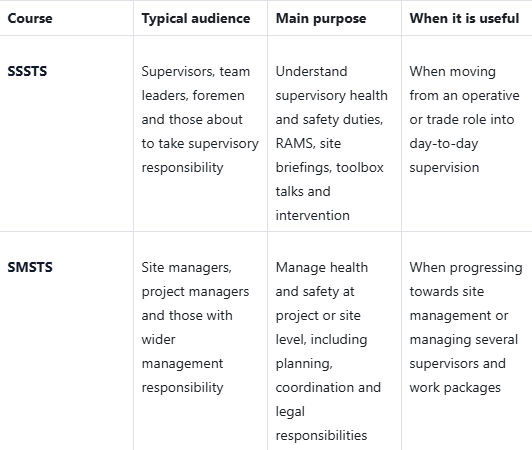
The CITB SSSTS course lasts two days. It is designed for people who have, or are about to have, supervisory responsibilities. The course covers health and safety law, risk assessments, method statements, inductions, toolbox talks, monitoring and timely intervention.
SMSTS is the broader five-day management course. It is generally more appropriate when your role involves managing a whole site, coordinating multiple work packages or taking responsibility for wider project-level health and safety arrangements.
Neither SSSTS nor SMSTS is a substitute for practical competence. Completing SSSTS does not automatically make you employable as a supervisor, and completing SMSTS does not automatically qualify you for every management role. Always check the specific requirements listed in the vacancy.
Do you need a Gold CSCS Supervisor card?
Many employers ask supervisors to hold an appropriate CSCS, ECS or equivalent card. The exact requirement depends on your occupation, the project and the card scheme covering your role.
The typical Gold CSCS Supervisor route involves:
- A relevant construction-related Supervisory or Technical NVQ/SVQ at Level 3 or 4.
- Passing the CITB Specialist Supervisory Health, Safety and Environment test.
- Applying for the card through the relevant CSCS process.
The CSCS Supervisory card guidance confirms that the card is available for supervisory and technical occupations subject to the required qualification and test.
Card rules and accepted qualifications can change. Check the current CSCS requirements and the exact vacancy before paying for training or applying. Some roles are covered by other schemes within the CSCS Alliance, while electrical and other specialist occupations may require an ECS or industry-specific card.
Qualifications and evidence employers may look for
Alongside SSSTS or SMSTS, employers may look for evidence of the following:
- NVQ Level 3 in a relevant trade or occupational area.
- A relevant supervisory qualification, such as Occupational Work Supervision or Construction Site Supervision.
- Gold CSCS Supervisor card, ECS card or another appropriate card.
- First aid training.
- Temporary works awareness.
- Lifting operations and lifting accessories awareness.
- RAMS knowledge and experience briefing safe systems of work.
- Understanding of CDM responsibilities and site documentation.
- Experience with quality inspections, snagging and handover records.
- Strong verbal and written communication.
- The ability to read drawings, specifications and work instructions.
- Confidence using digital site management, reporting or programme systems.
The strongest applications connect qualifications to practical results. For example, explain how you coordinated three trades to protect the programme, identified a sequencing problem before it caused delay or improved the quality of daily briefings.
Site supervisor, site manager or site operative?
Understanding the difference between these roles can help you target the right vacancies.
Site operative
A site operative carries out practical construction work, usually within a specific trade or work area. The role may involve using tools, plant and materials while following site rules, RAMS and instructions.
Site supervisor
A site supervisor coordinates and monitors the work of operatives and subcontractors. You remain close to the workface, checking safety, quality, progress, resources and compliance. You may supervise one trade or several teams.
Site manager
A site manager has broader responsibility for the delivery of a site or major project section. This can include programme, commercial coordination, resources, subcontractor management, client liaison, compliance and the supervision of supervisors.
Titles vary between employers. An assistant site manager role may include duties similar to a supervisor, while a working supervisor may still spend part of the day carrying out skilled work. Read the responsibilities carefully rather than relying on the job title alone.
Where can you find construction site supervisor jobs?
Site supervision is required across a wide range of construction and engineering environments, including:
- Housebuilding and residential developments.
- Commercial construction.
- Civil engineering and infrastructure.
- Utilities and groundworks.
- Refurbishment and fit-out.
- Industrial construction.
- Renewables and energy projects.
- Data centres.
- Rail, highways and transport projects.
- Specialist engineering and building services.
Your trade background may influence the most suitable vacancies. For example, an electrical supervisor may be well suited to data centres, utilities, infrastructure or commercial building services. A groundworks supervisor may target civils, housebuilding and infrastructure projects.
Use location and travel requirements carefully. OnBoard Jobs allows you to search construction-only listings using keyword matching and a location radius of up to 75 miles. Search for terms such as:
- Site supervisor.
- Construction site supervisor.
- Working supervisor.
- Trade supervisor.
- Assistant site manager.
- Finishing supervisor.
- Electrical supervisor.
- Civils supervisor.
- Fit-out supervisor.
How to improve your CV for site supervisor jobs
Your CV should show the scale and responsibility of your experience, not only list your tickets.
Include:
- The types of projects you have worked on.
- The trades, gangs or subcontractors you have coordinated.
- The value, size or stage of projects where relevant.
- Your experience with RAMS, toolbox talks and site inspections.
- The high-risk activities you have monitored.
- Your CSCS, ECS or other relevant cards.
- SSSTS, SMSTS, first aid and technical qualifications.
- Examples of improving safety, quality, productivity or coordination.
- The locations you can reach and your travel flexibility.
Use clear evidence. Instead of writing “supervised workers”, write “coordinated a team of six operatives and two subcontractors during the first-fix phase, maintaining daily briefings and reporting progress to the site manager”.
Prepare for a site supervisor interview
Expect questions about safety, communication, planning and how you respond under pressure.
Prepare examples showing how you have:
- Stopped unsafe work.
- Explained RAMS to a team.
- Delivered a toolbox talk.
- Resolved a clash between trades.
- Managed a late delivery or missing material.
- Identified poor-quality work.
- Supported an apprentice or less experienced worker.
- Reported a near miss or changing site condition.
- Kept work progressing without compromising safety.
Use a straightforward structure: explain the situation, what you were responsible for, the action you took and the result.
Start searching for site supervisor jobs
If you are ready to move from skilled operative to supervisor, build your profile around practical competence, safe leadership and reliable coordination.
Register with OnBoard Jobs to upload your CV, manage your candidate profile and set up tailored alerts for site supervisor jobs and other construction roles. Search construction-only vacancies without the dilution of retail, finance or hospitality listings.
Frequently asked questions
What qualifications do I need for site supervisor jobs?
Requirements vary, but employers may look for relevant trade competence, site experience, SSSTS, a suitable CSCS or ECS card and a supervisory NVQ/SVQ. First aid, RAMS, temporary works and lifting operations awareness can also strengthen your application.
Is SSSTS enough to become a site supervisor?
SSSTS is a common two-day course for supervisors and people moving into supervisory responsibility. It does not guarantee employment. Employers may also require occupational competence, leadership experience, the correct card and evidence that you can coordinate work safely.
Should I take SSSTS or SMSTS?
Take SSSTS if you are moving into day-to-day site supervision. SMSTS is the broader five-day course and is generally aimed at site managers or people with wider management responsibility. Check the vacancy requirements before booking either course.
Can a tradesperson become a site supervisor?
Yes. Many supervisors progress from skilled trade or operative roles. Build experience by leading small teams, supporting briefings, checking quality, coordinating work and taking responsibility for safe delivery.
What is the difference between a site supervisor and a site manager?
A site supervisor generally manages day-to-day work at the workface, including trades, safety, quality and progress. A site manager has broader responsibility for the site or project, including programme, resources, subcontractors, compliance and coordination of supervisors.